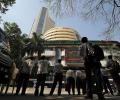
In the past four months, more than 4 million new accounts have been opened, taking the total to 44.3 million.

Investors who feel 'left out' by the run up in equity markets need not fret. They can still invest with a long-term view and make money.
With the downgrade there is a danger that investors who hold these financial securities may sell out. Of course, the level of selling will depend on the way the investors react to this downgrade.

Amidst heightened market volatility and muted investor sentiment, the Securities and Exchange Board of India (Sebi) has announced one-time relaxations for initial public offering (IPO) timelines and minimum public shareholding requirements, providing relief to numerous companies.

Delhi Police have arrested four individuals involved in an interstate racket manufacturing and distributing counterfeit prescription drugs, uncovering an illegal processing unit in Delhi.

From the 30-Sensex firms, Eternal, Infosys, Asian Paints, UltraTech Cement, Bajaj Finance, HCL Tech and Titan were among the biggest laggards. However, Tata Steel, Mahindra & Mahindra, Bajaj Finserv and Axis Bank were among the biggest gainers.
Home Minister's statement regarding the investment of terrorist funds in the stock market is yet another wake up call.

From the 30-Sensex firms, Maruti, Power Grid, Tata Motors Passenger Vehicles, HDFC Bank, Asian Paints and Tata Steel were among the biggest laggards. However, Titan, HCL Tech, Tech Mahindra, Infosys and Tata Consultancy Services were among the gainers.

The stock of automative major Eicher Motors hit its all-time high on Wednesday, capping the year with gains of about 52.7 per cent. It has comfortably outperformed its sector index, the Nifty Auto, which jumped 22.7 per cent, as well as the benchmark Nifty, which rose 10 per cent during this period.
Did the NSA mean the terrorists had used their advance knowledge of planned terrorist strikes in India to make money from the stock market?

Ajit Mishra, vice president, research, Religare Broking, answers your stock market queries.

India's manufacturing sector experienced a mild recovery in April, with the HSBC India Manufacturing Purchasing Managers' Index (PMI) rising to 54.7 from 53.9 in March. However, inflationary pressures intensified, with input costs increasing at the fastest pace since August 2022, largely attributed to the Middle East conflict.
The Dalal Street was on Tuesday abuzz with an eerie coincidence that took place last night in the Wall Street, the US stock market, with its benchmark index S&P 500 closing at a level exactly same as that of October 3, 2008.

Shares of tyre manufacturers have outperformed broader equity benchmarks, buoyed by multiple tailwinds. Softer raw material prices, an uptick in demand from automakers following the reduction of the goods and services tax (GST) rates, and steady replacement demand have lifted sentiment toward the sector.

The government has dismissed speculation of an imminent increase in petrol and diesel prices, assuring citizens that there are no plans for a hike despite rising crude oil costs.

All the countries in the top 10 have seen a decline in market value.

The Enforcement Directorate (ED) conducted raids at multiple locations in West Bengal as part of a money laundering investigation into an alleged Public Distribution System (PDS) scam.

Overseas investors have poured Rs 43,837 crore ($9.05 billion) into the country's stock markets so far this year, reflecting confidence of foreign funds in the Indian equity markets.

Overall market reaction to the Budget was neutral. Investors absorbed the changes to the tax rates (positive for salaried class) and capital gains taxes (CGTs, negative due to the removal of indexation and increases. Other proposals largely pertain to supporting rural development, buybacks taxed as dividends, Custom duty changes that impact multiple sectors, higher outlays for clean energy, etc. There's some moderation in the growth of capex outlay across defence, fer

Indian investors have seen their wealth erode by a staggering Rs 48.29 lakh crore since the West Asia war began on February 28, leading to a significant downturn in the BSE Sensex and NSE Nifty, driven by geopolitical tensions and rising crude oil prices.
Stock markets will be driven by inflation data, trade-related news, earnings and trading activity of foreign investors in a holiday-shortened week, analysts said on Sunday. Global market trends will also influence trading sentiment this week, they added.

ICICI Bank, Eternal, Titan, Adani Ports, Tata Consultancy Services and UltraTech Cement were also among the laggards. However, InterGlobe Aviation, Tech Mahindra, Hindustan Unilever and Bajaj Finance were among the gainers.

The European Union's (EU's) offer to slash tariffs on 97.5 per cent of Indian chemical exports to zero is set to give India's pharmaceutical and medical device firms preferential access to the European markets.
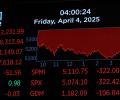
'If the US stagnates and falls into a recession, the dollar will weaken, oil prices will also dip. This augurs well for India.'

Among the Sensex firms, IndusInd Bank, Tata Steel, Tata Motors, Sun Pharma, Infosys, Mahindra & Mahindra, Infosys, NTPC, Bharti Airtel, HCL Technologies and Axis Bank were the biggest gainers. Tech Mahindra and Bajaj Finance were the laggards.

Around one full month of supply is firmly arranged with additional procurement being continuously finalised, and oil companies are successfully delivering over 5 million cylinders every day.

'It is too early to conclude that there will be a bloodbath, that there will be no jobs, and that there will be civil unrest.' 'Let's calm down.' 'AI is a tool, it is not a weapon, it is not a virus.'

Shares of Waaree Energies and Premier Energies are under pressure after the US imposed initial duties on Indian solar imports. The article examines the impact on green energy stocks and market sentiment.

'In investing, poor sentiment is always a good vintage to build a portfolio.'
Without doubt, bears have raided. We try to fathom what further damage could they cause, for how long and how to cope with it.

Trading sentiment in the equity market will be guided by macroeconomic data announcements, global trends and quarterly earnings from IT major TCS this week, analysts said. Stock markets would also be tracking trading activity of foreign investors who remained net sellers of Indian equities in September.

The Indian government has doubled the daily quota of market-priced 5-kg LPG cylinders for migrant workers to ensure stable fuel supplies amidst global disruptions. This move prioritises household cooking gas and addresses the needs of migrant workers who often lack regular connections.

To become an algorithmic trader, you need three things: Knowledge of financial markets, quantitative skills, and coding skills, suggests Nitesh Khandelwal.

Stock markets closed lower for the second straight day on Friday amid relentless foreign fund outflows and losses in blue-chip stocks Reliance Industries, ICICI Bank and State Bank of India. Benchmark BSE Sensex declined by 55.47 points or 0.07 per cent to settle at 79,486.32. During the day, it tanked 424.42 points or 0.53 per cent to 79,117.37.
Does full-time share trading show poor returns for health?

Markets rallied because of huge inflows by overseas investors.
Sebi is working with other regulators to expand the CAS framework.

Invesors are caught between bullish China and bearish India.

Since this is a long-term investment, investors must do their homework and choose a fund manager carefully.

Donald Trump has launched a scathing attack on Pope Leo XIV over the pontiff's views on American foreign policy and crime, escalating tensions between the White House and the Vatican.
